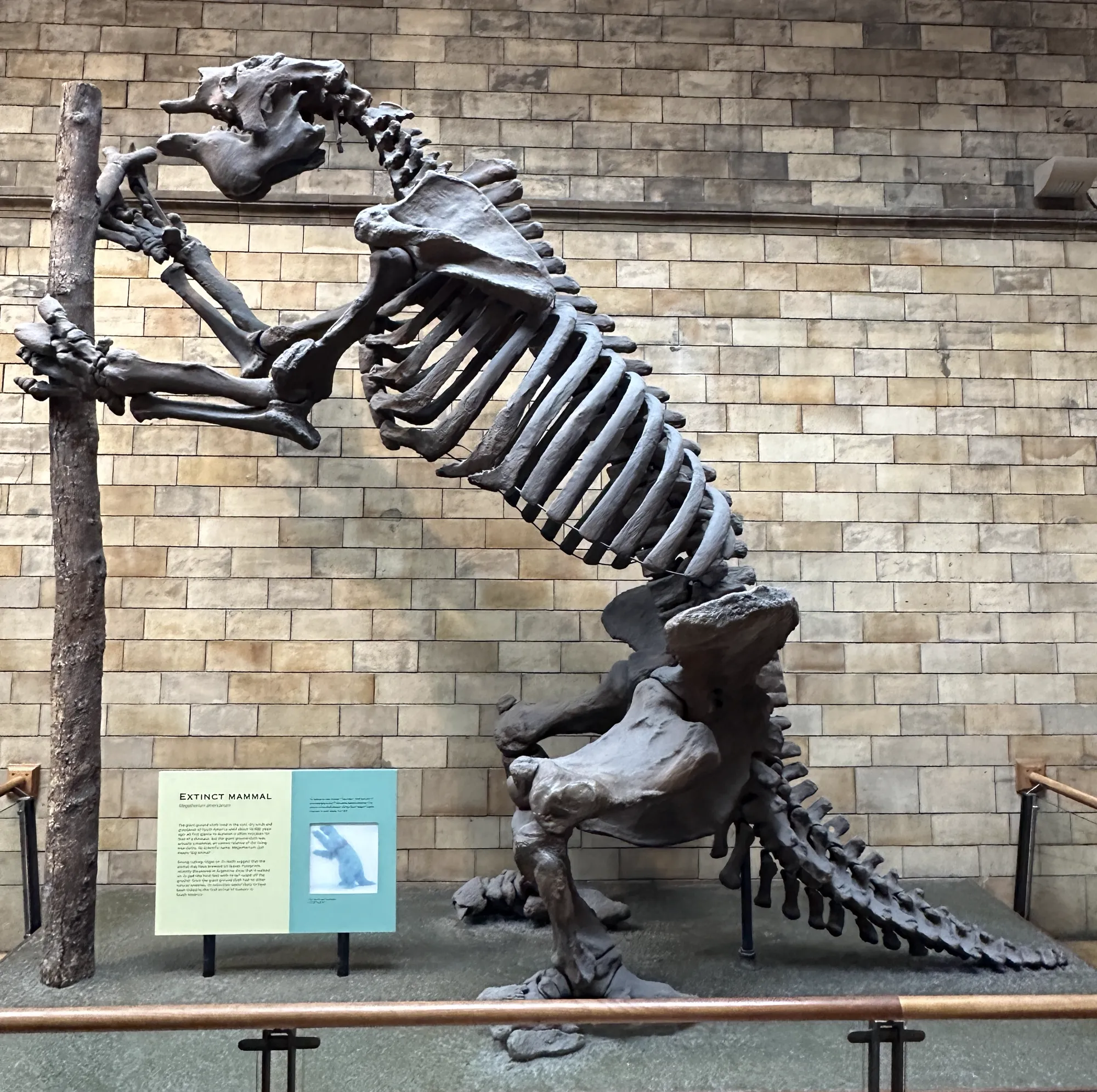
The two living genera are the last leaves on a huge tree: more than a hundred genera of sloth have been described from the fossil record, and most of them lived on the ground. Some were the size of bull elephants. Some swam in the Pacific. Some dug tunnels you can walk through today. The hanging, leaf-paced animal on the previous pages is the family’s low-power survival mode — and it worked, twice, while every giant died.
genera of sloth in the fossil record, against two alive today (Delsuc et al. 2019)
Megatherium americanum — bull-elephant class, rearing to ~3.5 m (NHM; Boscaini et al. 2025)
of branching tunnel in the largest Brazilian paleoburrow, claw marks on the walls
years ago: a butchered Megatherium at Campo Laborde, Argentina — people were there
The scale of the thing
One axis, three sloth-shaped facts
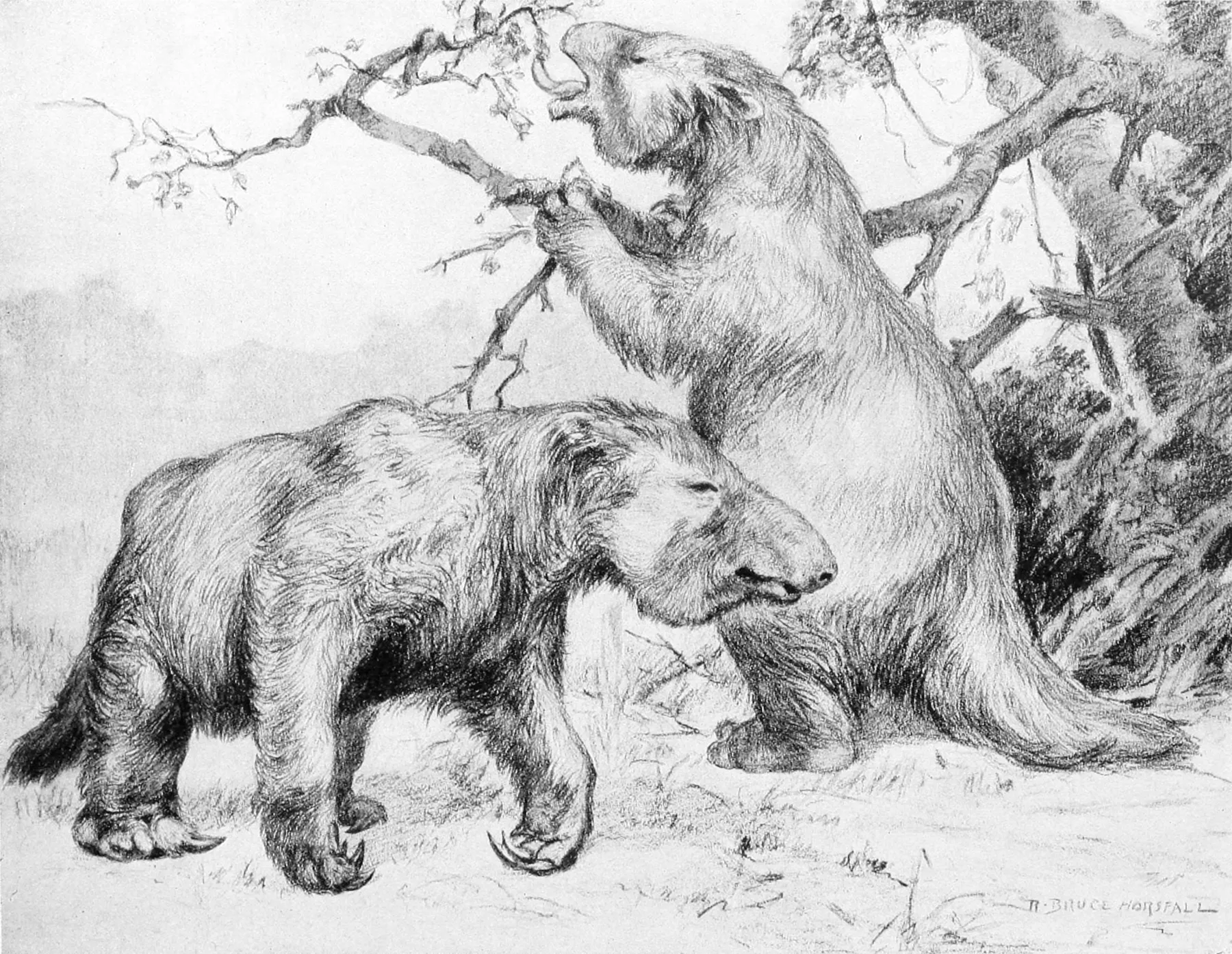
Cuvier named Megatherium americanum — “great American beast” — in 1796 without ever seeing the bones, working from engravings of a skeleton shipped from Argentina to Madrid. That skeleton, mounted in 1788–89, was the first fossil skeleton ever assembled in any museum, and it helped establish an idea that was still radical: that species can cease to exist.
From four tonnes to four kilograms: the sloth's ten-thousandfold retreat
Height on one axis, drawn to scale. Megatherium americanum reared to about 3.5 m and weighed roughly 3.6 tonnes; a person stands 1.75 m; a living three-toed sloth is about 60 cm of body and 4.3 kg, hanging from a branch it will not leave this week. Silhouettes are schematic; the heights are the data.
Source: Natural History Museum, London (Megatherium: up to 4 t, 3.5 m rearing, 'largest bipedal mammal of all time'); Boscaini et al. 2025, Science (~3.63 t); Animal Diversity Web (B. variegatus: avg 4.34 kg, ~60 cm).
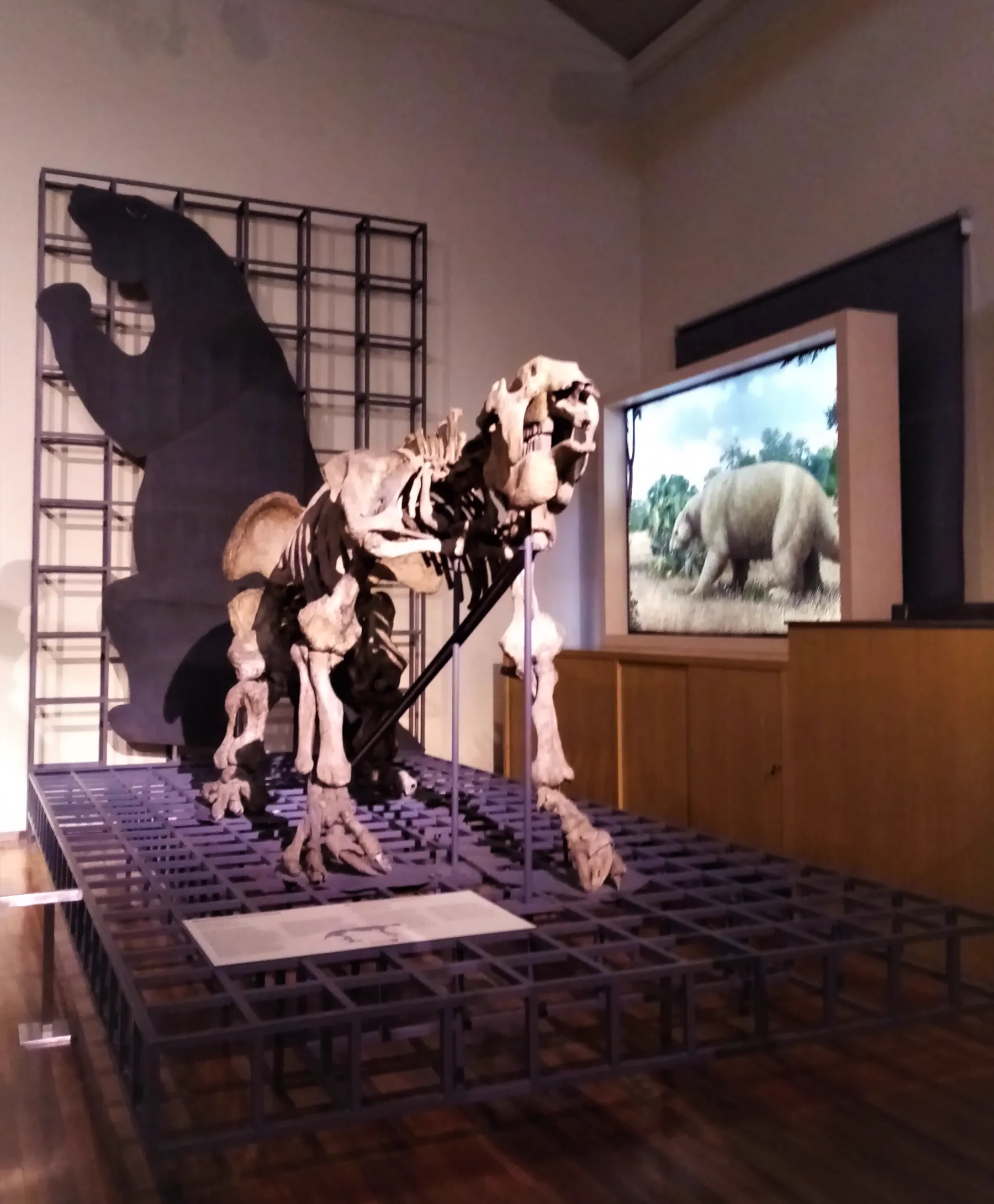
The range of the experiment
Sea sloths, tunnel sloths, and a family tree with a twist
They went to sea. Thalassocnus, from the coastal deserts of Peru, is five successive species across about four million years whose bones grow steadily denser — ballast, the same trick manatees use — as the lineage waded further out to graze seagrass. It is one of the most complete fossil records anywhere of a land animal partway through becoming a marine one.
They went underground. Southern Brazil is riddled with paleoburrows — smooth-walled tunnels, some six feet tall, the largest running to roughly six hundred metres with branches — attributed to ground sloths and giant armadillos. The giveaway is on the ceilings: grooves matching the diggers’ claws. Geologist Heinrich Frank, who has catalogued more than 1,500 of them, puts it plainly: no geological process makes branching elliptical tunnels with claw marks.
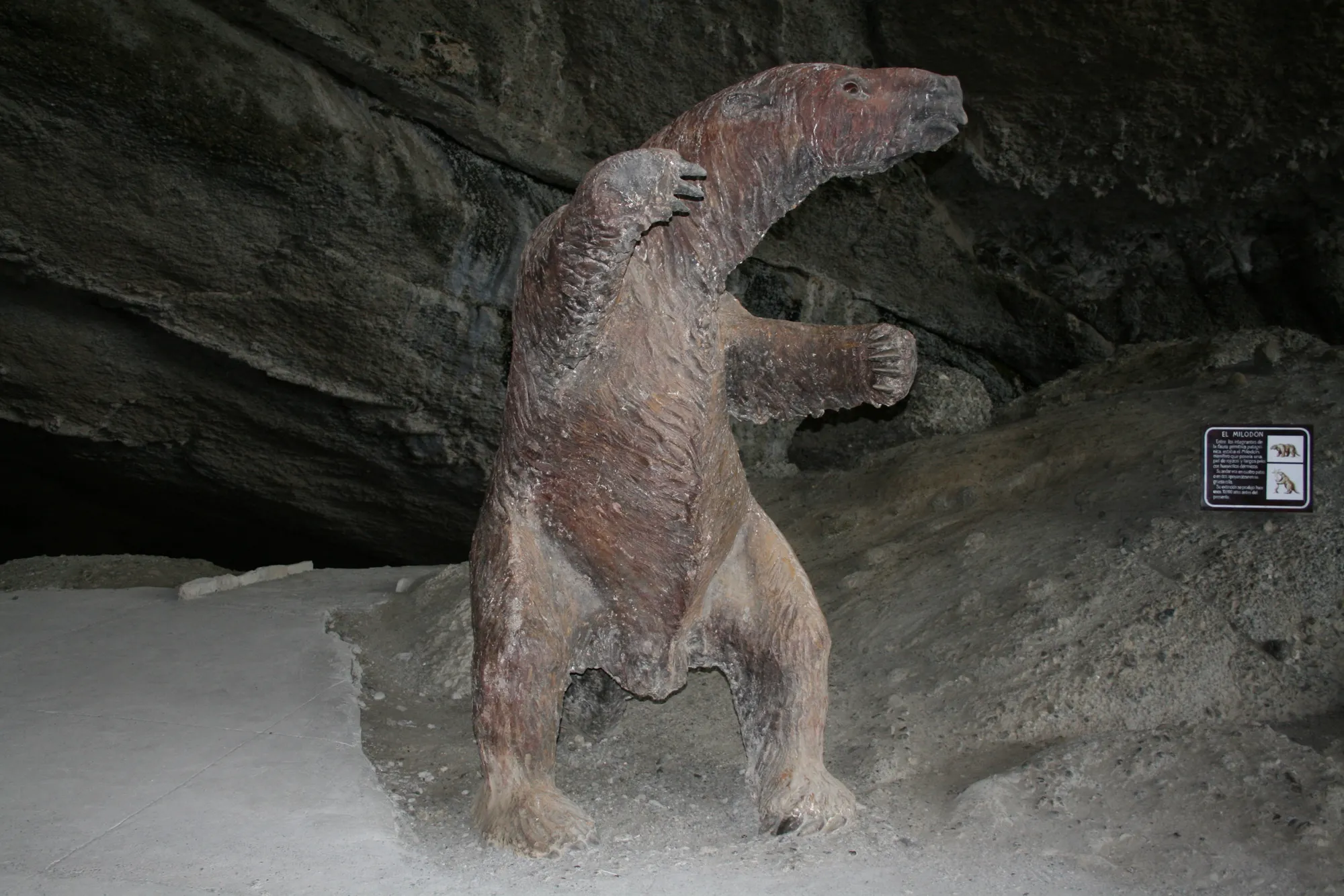
And the survivors rewrote the tree. In 2019, protein and ancient-DNA studies of fossil sloths — including Darwin’s own Mylodon, collected on the Beagle voyage and named for him by Richard Owen — showed the two living genera each sit closer to different extinct giants than to each other. Two-toed sloths are the last of the Mylodon line; three-toed sloths sit among Megatherium’s kin. Tree-hanging is a convergence, not an inheritance: the family’s only two survivors invented the same escape independently.
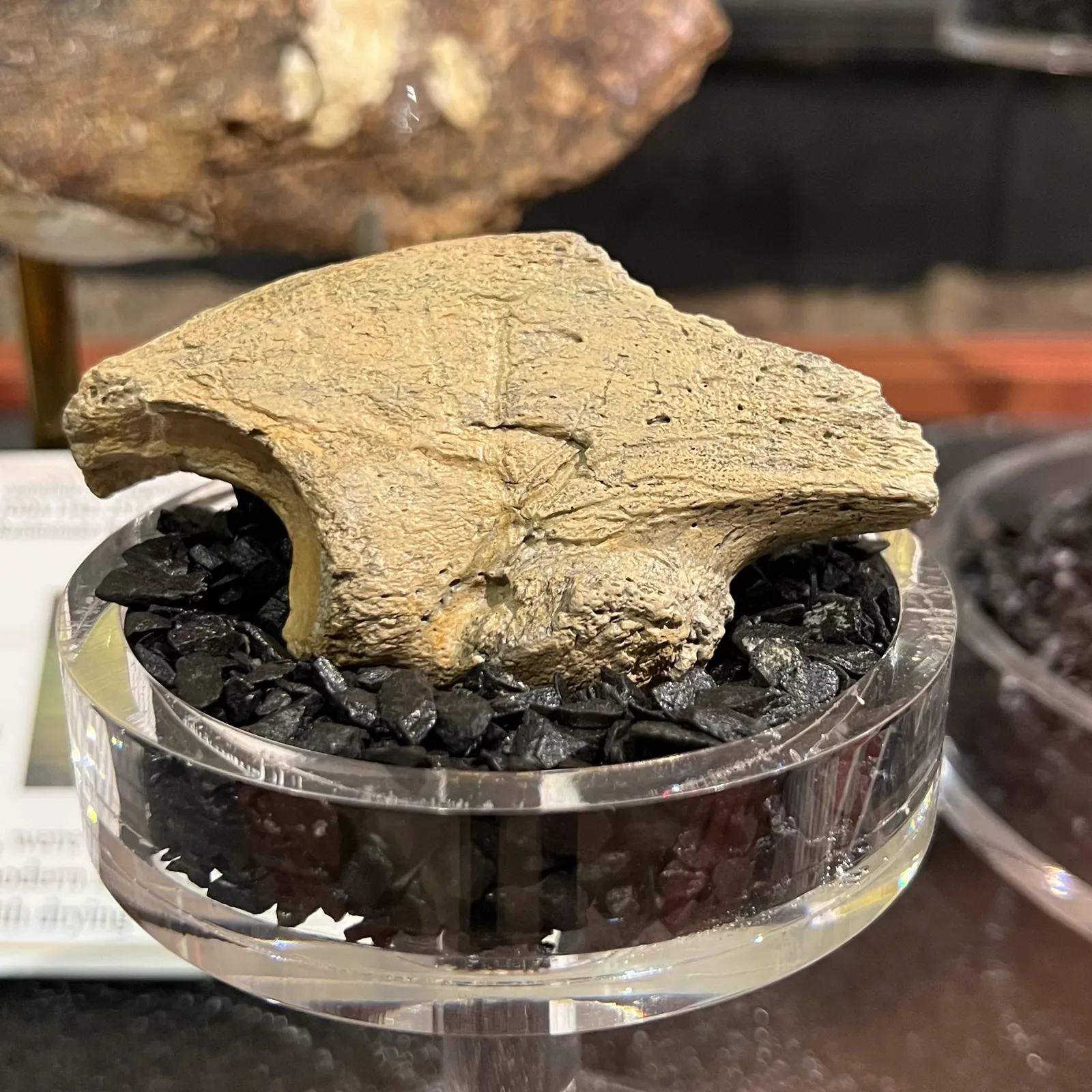
The ending
People watched them go
The giants vanished from the mainlands around eleven to ten and a half thousand radiocarbon years ago — and the evidence increasingly shows humans in the frame. At White Sands, New Mexico, fossil trackways preserve people literally walking inside a ground sloth’s footprints while the animal wheels and rears — a stalk, frozen in gypsum. At Campo Laborde in Argentina, a Megatherium was killed and butchered on the edge of a swamp about 12,600 years ago; a stone projectile point lay among the bones.
The clinching detail is the islands. On Cuba and Hispaniola, where humans arrived thousands of years later, ground sloths survived thousands of years longer — into roughly the era the pyramids were being built — and then disappeared there too, shortly after people landed. As the 2005 PNAS synthesis put it, the sloths’ last dates track the first arrival of people, on continents and islands alike, better than they track any climate event.
Checked — what gets repeated vs what was measured
A charming hypothesis, not a finding. It descends from Janzen & Martin’s 1982 “neotropical anachronisms” paper — which proposes megafauna dispersed big-seeded fruits but never names the avocado; gomphotheres (elephant kin), not sloths, are its stars. The avocado became the poster child via Connie Barlow’s 2001 book. Plausible, widely repeated, untested.
The paleoburrows are real, mapped in the thousands, and carry claw marks matching ground sloths and giant armadillos — with the largest tunnels generally credited to the sloths on size. The measurements here come from the researchers’ fieldwork as reported in Discover (2017); the primary surveys are in regional geology journals.
The timing is damning (last dates track human arrival on two continents and then, millennia later, on the islands — Steadman et al. 2005) and the direct evidence is real (White Sands trackways; the Campo Laborde butchery site). But climate shifted too, and the field still argues about the mix. What is settled: people and giant sloths met, and only one walked away.
Sources for this page
- Delsuc et al. 2019, Current Biology — ancient mitogenomes; >100 genera; the convergence
- Presslee et al. 2019, Nature Ecology & Evolution — collagen phylogeny of sloths
- Natural History Museum, London — Megatherium (size, Madrid history) and Mylodon darwinii (the Darwin/Owen story)
- Amson et al. 2014, Proc. R. Soc. B — Thalassocnus: five species, four million years, densifying bones
- Jenner 2017, Discover — the Brazilian paleoburrows, reporting Heinrich Frank's fieldwork
- Steadman et al. 2005, PNAS — last dates on continents (~11,000 ¹⁴C yr) and islands (~4,400 ¹⁴C yr) track human arrival
- Bustos et al. 2018, Science Advances — the White Sands human-inside-sloth-tracks trackways
- Politis et al. 2019, Science Advances — Campo Laborde: a butchered Megatherium at ~12,600 cal BP
- Janzen & Martin 1982, Science — 'Neotropical Anachronisms', the root of the avocado story
Mass figures for Megatherium vary by method; this page prints the range carried by the loaded sources (~3.6–4 t) rather than the older, higher allometric estimates. Next: how the seven survivors are doing.