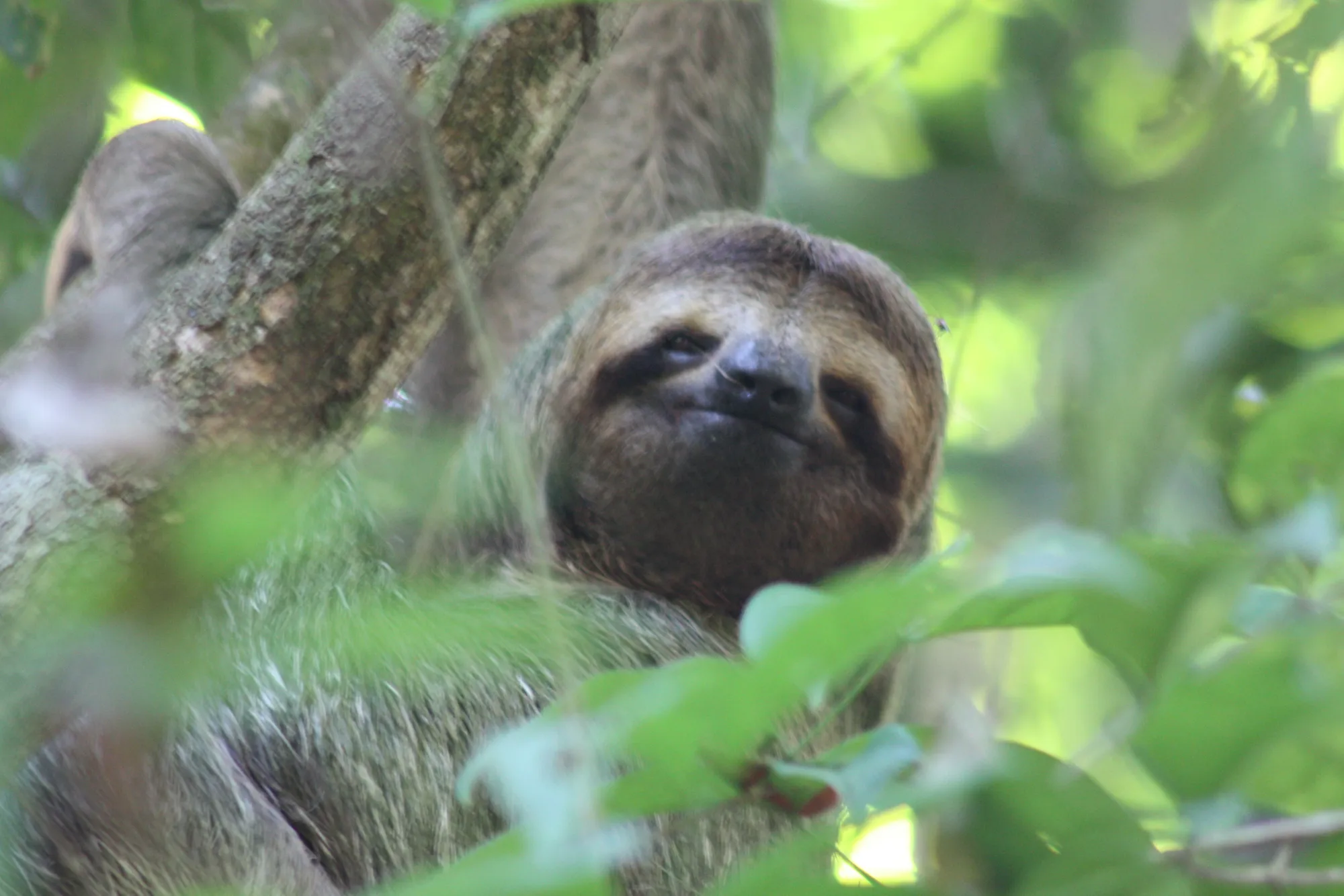
A sloth is a leaf-powered mammal that hangs from the rainforest canopy between southern Honduras and southern Brazil. Leaves are terrible food — hard to digest, barely caloric — and rather than work harder for better meals, sloths spent the last few tens of millions of years lowering their costs until leaves were enough. The result is an animal that runs on about 110 kilocalories a day, roughly a fried egg and a half. This issue takes that budget seriously: six pages, one animal, every figure from a primary source, and the internet’s favourite sloth “facts” checked against what was actually measured.
living species, in two genera — five three-toed, two two-toed (IUCN specialist group list)
a wild three-toed sloth's day of energy — the lowest field metabolic rate measured in any mammal (Pauli et al. 2016)
tree-hanging evolved independently in the two living families; they are not close kin (Presslee 2019; Delsuc 2019)
species whose populations the IUCN lists as decreasing — including every 'Least Concern' one
The two kinds
Three fingers, two fingers, and forty million years of distance
Every living sloth is one of two models. Three-toed sloths (genus Bradypus, five species) are the smaller, rounder, masked ones — day-active, leaf-only, and so committed to slowness that their body temperature drifts with the weather. Two-toed sloths (genus Choloepus, two species) are bigger, nocturnal, snoutier, and slightly less strict about all of it. The names undersell the difference: even their necks disagree. Three-toed sloths carry eight to ten neck vertebrae — nearly every other mammal, giraffe included, has exactly seven — which is why one can turn its face most of the way around its back. Two-toed sloths went the other direction, down to as few as five.
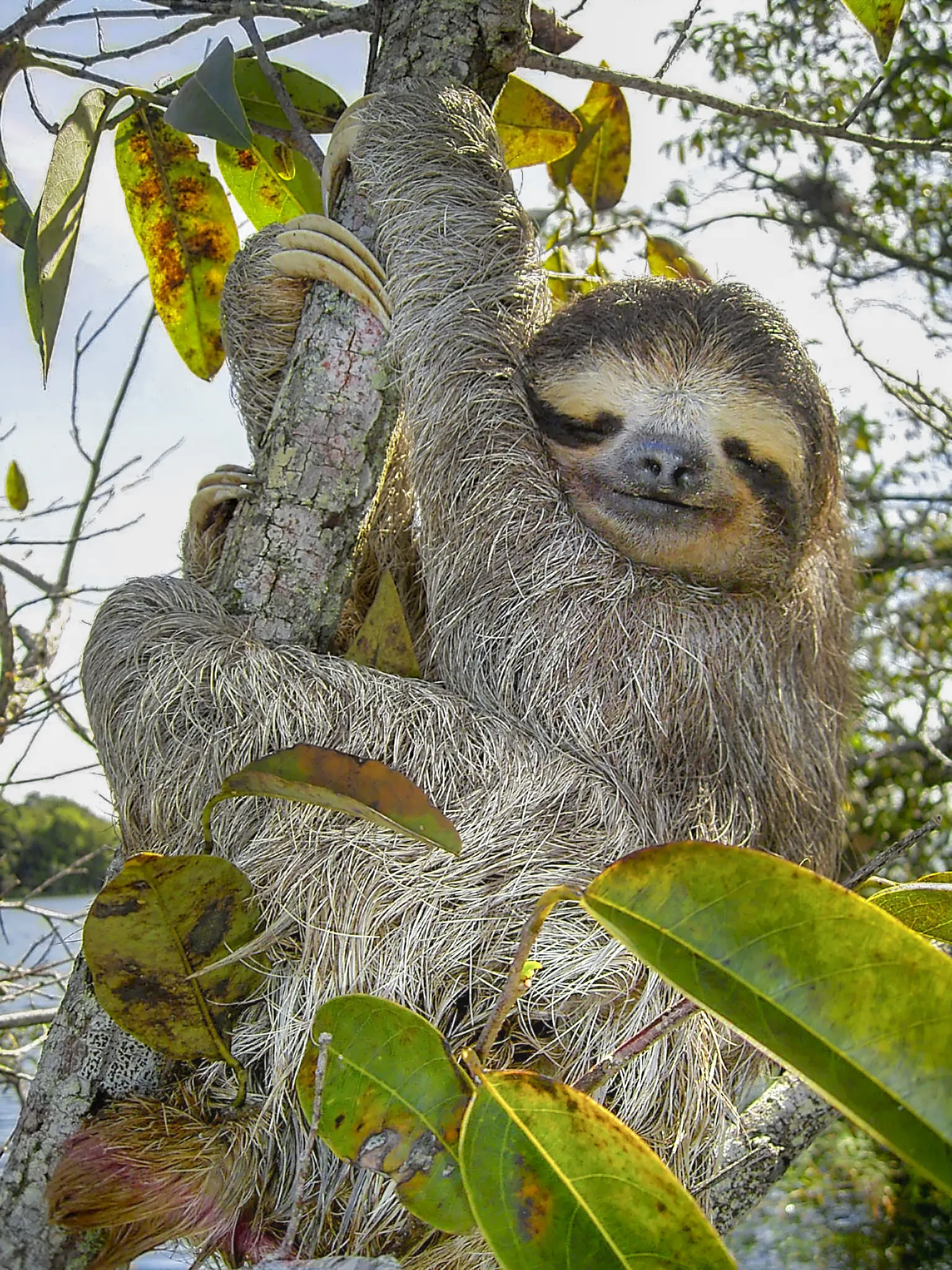
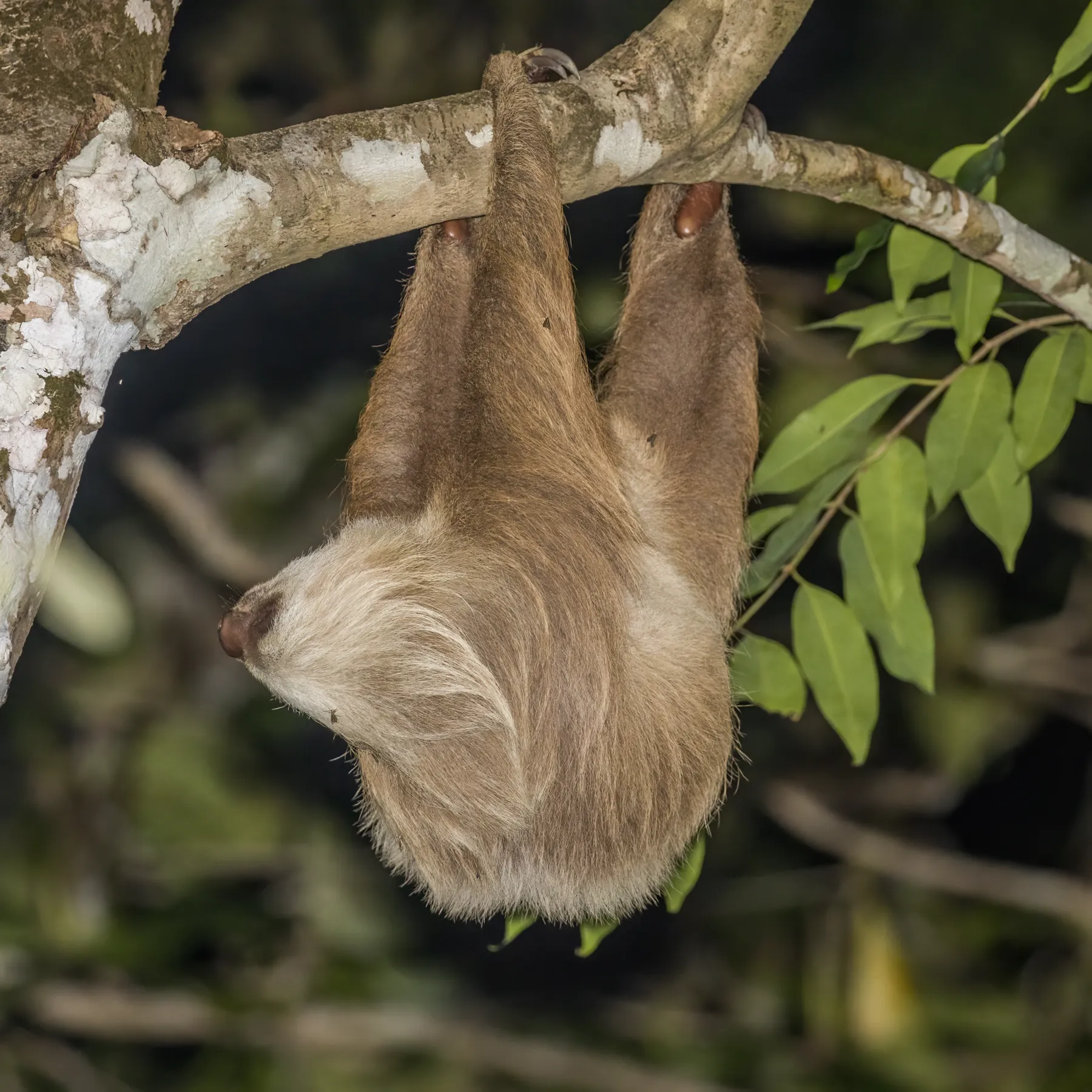
Here is the part that reads like a twist. The two families look like variations on one design, and they are not. Molecular work on ancient proteins and DNA showed in 2019 that two-toed sloths are closest to the extinct giant ground sloths of the Mylodon line, while three-toed sloths sit nearer Megatherium’s side of the family tree. Their common ancestor lived on the ground. Hanging upside down from branches was invented twice, independently — the slow, inverted, hook-handed lifestyle is apparently such a good answer to the leaf-eating problem that evolution bought it two separate times. Page 5 tells that story, elephants included.
Moving picture
What slow actually looks like
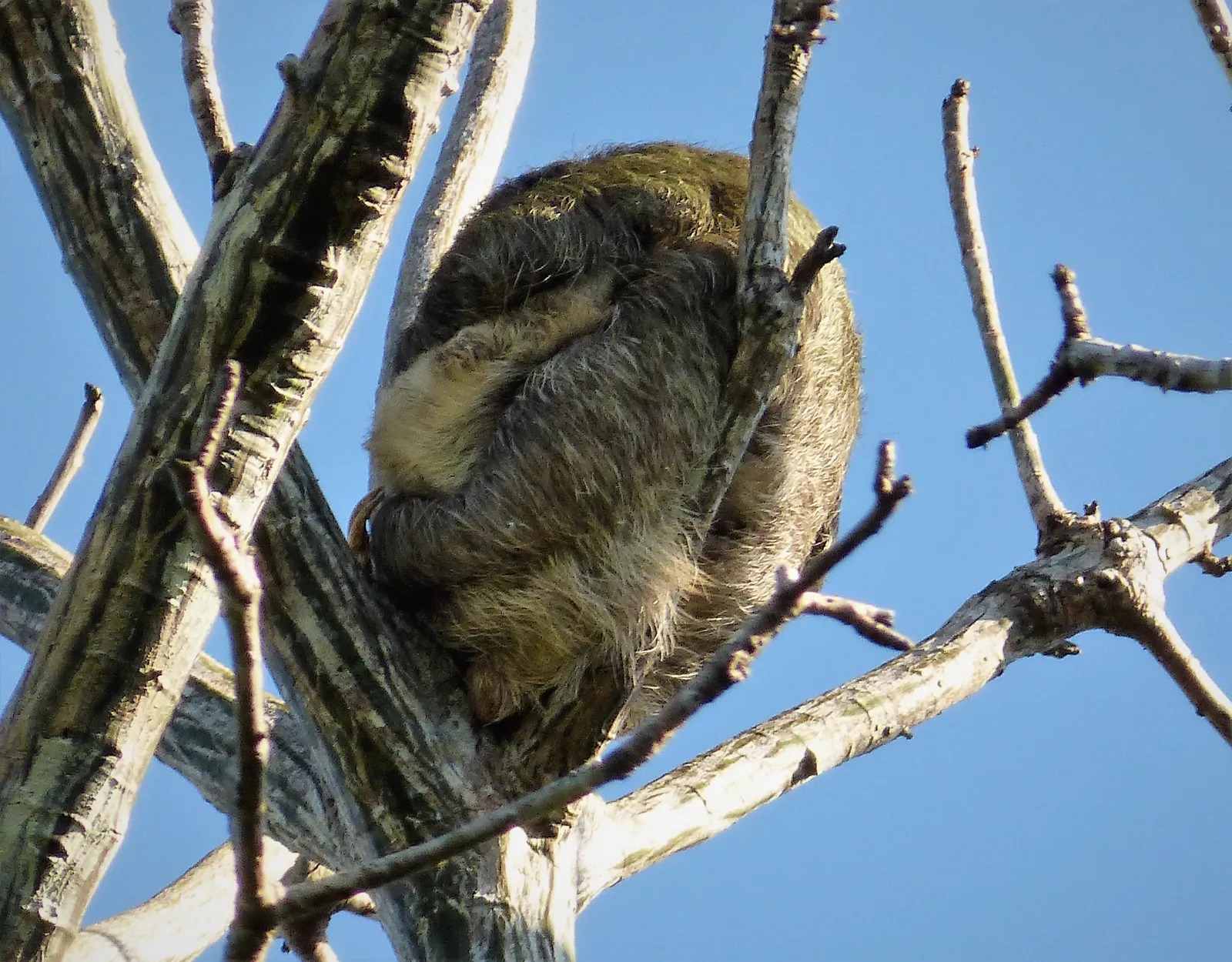
Numbers first, footage second. A wild three-toed sloth rarely covers more than 38 metres in a day, and its cruising speed hand-over-hand under a branch is about nine centimetres a second. Watch the gait, though, and “slow” stops looking like the right word — it moves like something with nowhere to be and no interest in being seen.
Checked — what gets repeated vs what was measured
Backwards. The 2016 field-metabolism study that clocked them at ~460 kJ/day called it a strategy: arboreal leaf-eaters cap their energy output, and three-toed sloths do it best of any mammal ever measured. Slowness is the discipline, not the defect (Pauli et al. 2016, The American Naturalist).
Collagen and ancient-DNA phylogenies (Presslee et al. 2019, Nature Ecology & Evolution; Delsuc et al. 2019, Current Biology) both found the living families are only distantly related — each is closer to different extinct ground sloths than to the other. The hanging lifestyle evolved twice.
The primary literature says otherwise: on the ground sloths walk — awkwardly, soles and forearms, a proper stepping gait — and “do not drag themselves across the ground” (Mendel 1985, via the Mammalian Species account). It looks like crawling because the limbs are built for hanging, not standing.
Sources for this page
- IUCN SSC Anteater, Sloth and Armadillo Specialist Group — species list (seven living species)
- Pauli et al. 2016, The American Naturalist — the lowest field metabolic rate recorded for any mammal
- Presslee et al. 2019, Nature Ecology & Evolution — collagen phylogeny: suspension evolved twice
- Delsuc et al. 2019, Current Biology — ancient mitogenomes agree
- Cervical count and 240° head roll — 2023 range-of-motion study (PMC)
- Sunquist & Montgomery 1973, Journal of Mammalogy — the 38 m/day figure
- Hayssen 2010, Mammalian Species — the Bradypus variegatus account (gait, neonate grip)
Compiled 21 August 2026. Photographs from Wikimedia Commons under the licenses printed in each caption; click any credit’s source on the colophon for the file pages.