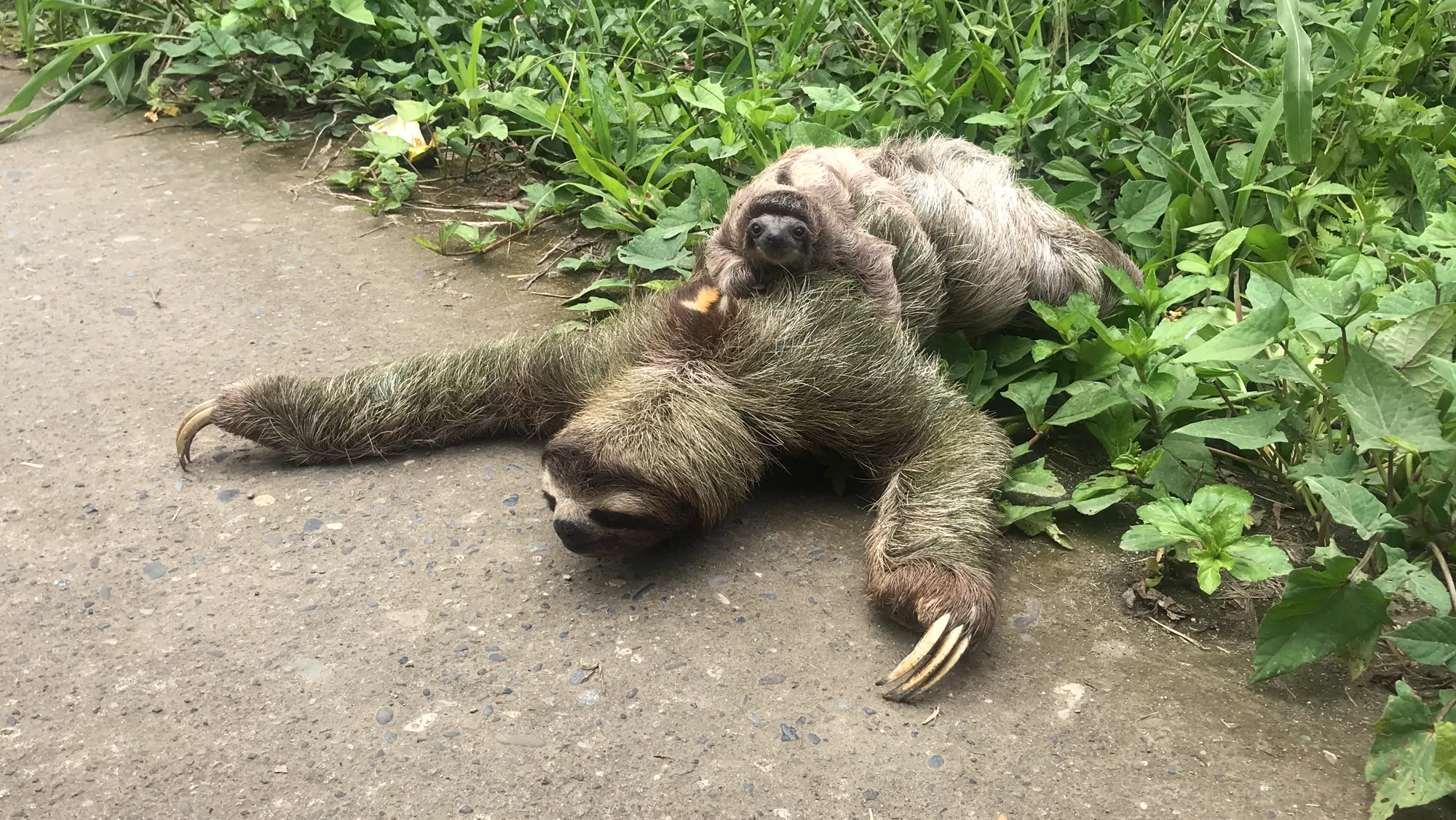
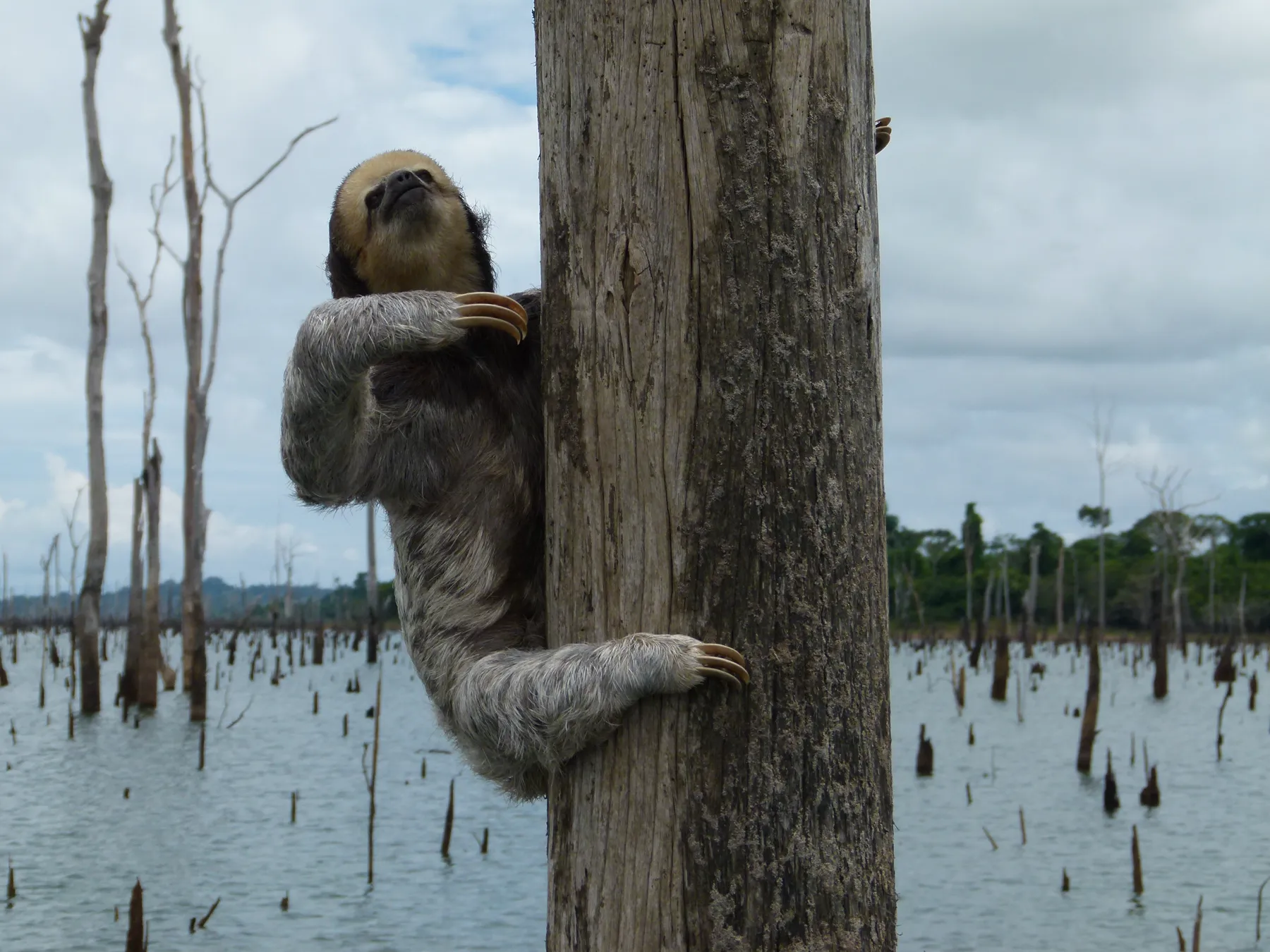
The canopy is the whole of a sloth’s security: camouflage, stillness, height. And roughly every four to eight days a three-toed sloth gives all of it up, climbs down its own tree, digs a small depression at its base with the stump of its tail, defecates into it, covers the work with leaf litter, and climbs back up. The trip costs about 8% of a day’s energy on an already absurd budget, and it is where sloths die: in the field data behind the famous 2014 mutualism paper, more than half of all documented adult deaths were predation at or near the ground. The obvious alternative — let it drop from the branch, as two-toed sloths sometimes do — is free. Three-toed sloths almost never take it. Why not is one of the best open questions in mammalogy.
between descents for a wild brown-throated sloth (Montgomery & Sunquist, via the Mammalian Species account)
of the daily energy budget spent on one round trip (Pauli et al. 2014)
of documented adult deaths were predation at or near the ground (Pauli et al. 2014)
of body mass held as stored faeces and urine before a void (Goffart 1971, via Cliffe et al. 2014)
The ritual
Down the tree it lives in
The details are oddly formal. The descent is usually made down the sloth’s own modal tree, not a random one. The pit is dug, used, and covered — a latrine, maintained. A week’s holding means the load is genuinely large; the literature’s figure, traced back to a 1971 monograph, is that a sloth can be carrying up to a third of its body weight in waste when it goes. Then the slowest climber in the forest makes the slowest possible exit from the scene of maximum exposure.
The theories
Four explanations, none settled
1 · Feeding the landlord. The oldest idea (Montgomery & Sunquist, 1975): dung at the roots fertilises the tree the sloth eats from. Tidy, but a sloth’s weekly output is a rounding error in a rainforest’s nutrient flow, and the theory has never been demonstrated.
2 · Serving the garden. The 2014 Pauli hypothesis: the latrine is where the sloth’s fur-dwelling moths breed, the moths enrich the fur with nitrogen, the nitrogen feeds the algae, and the algae pay the sloth back. The descent, on this view, is agricultural infrastructure. Page 4 lays the whole loop out, numbers and objections included.
3 · The bulletin board. Sloths are near-silent, solitary, and short-sighted; a maintained latrine full of pheromones would be a way to tell the neighbourhood who is around and who is in oestrus. Field researchers lean on this one increasingly — but as of this writing it lives in reviews, book chapters and unpublished data, not in a peer-reviewed test.
4 · Nobody ever asked them to stop. The 2021 rejection paper’s answer: ground sloths defecated on the ground for tens of millions of years, and their descendants simply kept the ancestral habit because selection never produced a strong enough reason to drop it. The least romantic hypothesis, and the hardest to falsify.
Checked — what gets repeated vs what was measured
Close to the sourced wording, which is worth quoting exactly: “more than one-half of all adult sloth mortalities we have documented were depredation events when sloths were at or near the ground” (Pauli et al. 2014, citing their Costa Rica demography work). It is a share of documented deaths — not a per-trip risk, and not literally “at the latrine.”
The traceable version: sloths “store up to a third of their body weight in faeces and urine before voiding” (Cliffe et al. 2014, citing Goffart’s 1971 monograph). Storage capacity, faeces and urine together — the one-mighty-poop framing is the internet’s edit.
We could not trace a timed measurement anywhere in the primary literature; the leading sloth NGO says only that the act itself “lasts a few moments.” Undocumented, as far as we can find.
Sources for this page
- Pauli et al. 2014, Proc. R. Soc. B — the descent's cost, ritual, and mortality figure
- Peery & Pauli 2014, J. Applied Ecology — the demography study behind the mortality tally
- Cliffe et al. 2014, Biology Letters — the stored-waste figure (via Goffart 1971)
- Voirin, Kays, Wikelski & Lowman 2013 — 'Why Do Sloths Poop on the Ground?' (Treetops at Risk)
- Monge-Nájera 2021, UNED Research Journal — the ancestral-habit rejection of the mutualism model
- Hayssen 2010, Mammalian Species — descent every ~8 days in the wild