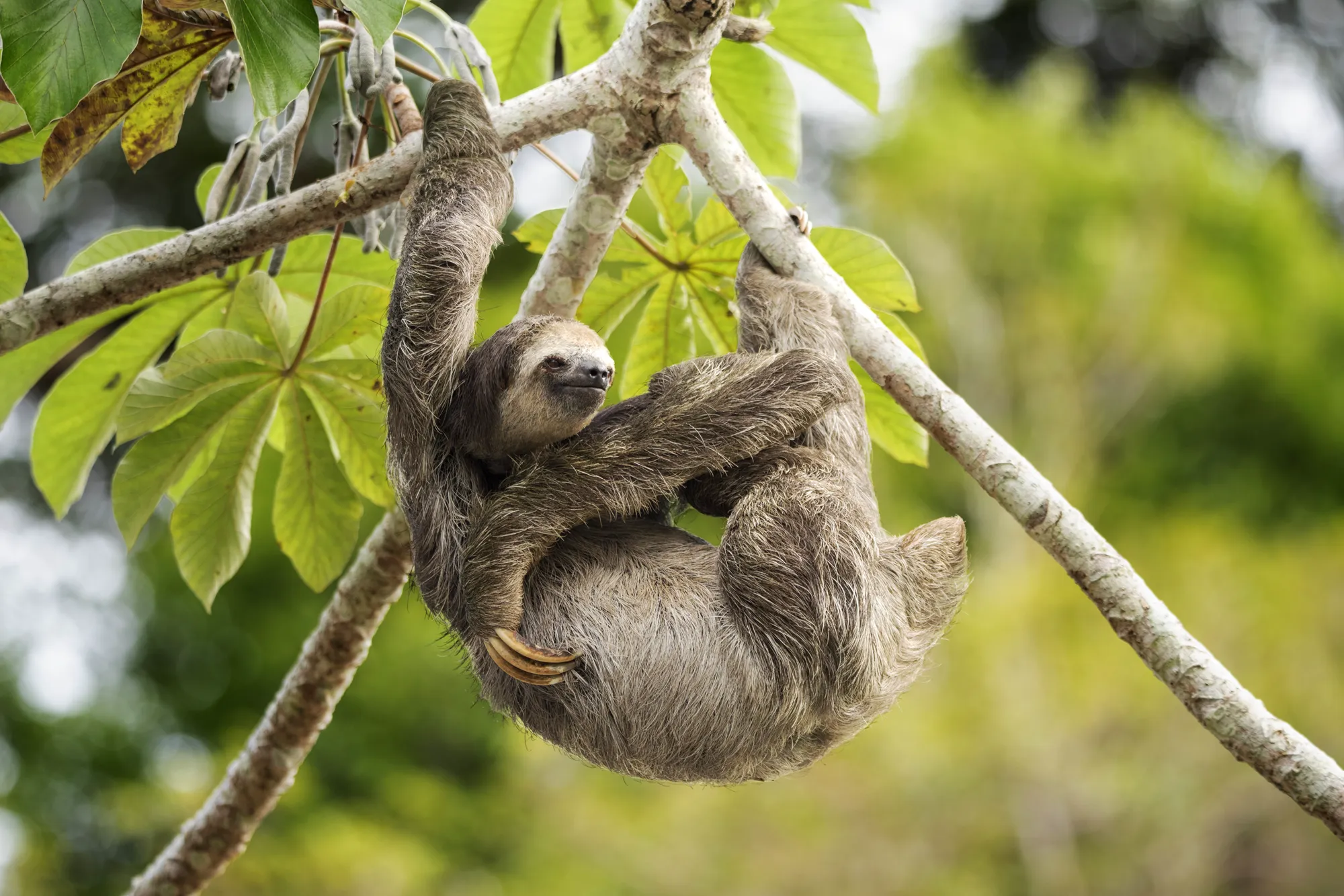
In 2016, researchers fitted wild sloths in Costa Rica with doubly-labelled water — the standard trick for measuring what a free-living animal actually spends — and got a number nobody had seen before: three-toed sloths ran on the lowest field metabolic rate ever recorded for a mammal, about 460 kilojoules a day. That is the whole enterprise: moving, digesting, staying warm, being a sloth — for roughly 110 kilocalories. A slice of bread costs more. This page is the itemised budget.
a wild three-toed sloth's daily spend — 162 kJ/day·kg^0.734, the mammal record (Pauli et al. 2016)
resting metabolism vs the textbook prediction for a mammal its size (Cliffe et al. 2018)
of body mass that is muscle — the machinery was pared down (Grand 1978)
of body mass that can be stomach and gut contents — the fuel tank was enlarged (Cliffe et al. 2015)
The line items
Where the savings come from
Heating, mostly cancelled. Mammals usually pay a constant fuel bill to hold one body temperature. Sloths let the thermostat drift: loggers on wild animals recorded cores wandering between 30.2 and 34.9 °C with the day’s weather, and the classic physiology work concluded they regulate metabolism by varying body temperature rather than burning fuel to fight it. One 2018 lab study found something stranger still — above about 30 °C ambient, their metabolism goes down, the first mammal seen idling its engine in the heat without entering torpor.
Machinery, sold off. Muscle is expensive to keep even when idle, so sloths keep little: about 24% of body mass, against the considerably larger share typical of mammals their size. What remains is nearly all slow-twitch fibre — around 90% in the hindlimb — built for holding on, not for hurrying.
Rent, zero. The hanging itself is close to free. The claws are hooks, and the finger tendons carry body weight passively — measured safety factors run from about 2.5× body weight on a single limb to 7–10× spread across three — so a sloth drapes from a branch the way a coat hangs from a peg. It can sleep like that. It can die like that and not fall.
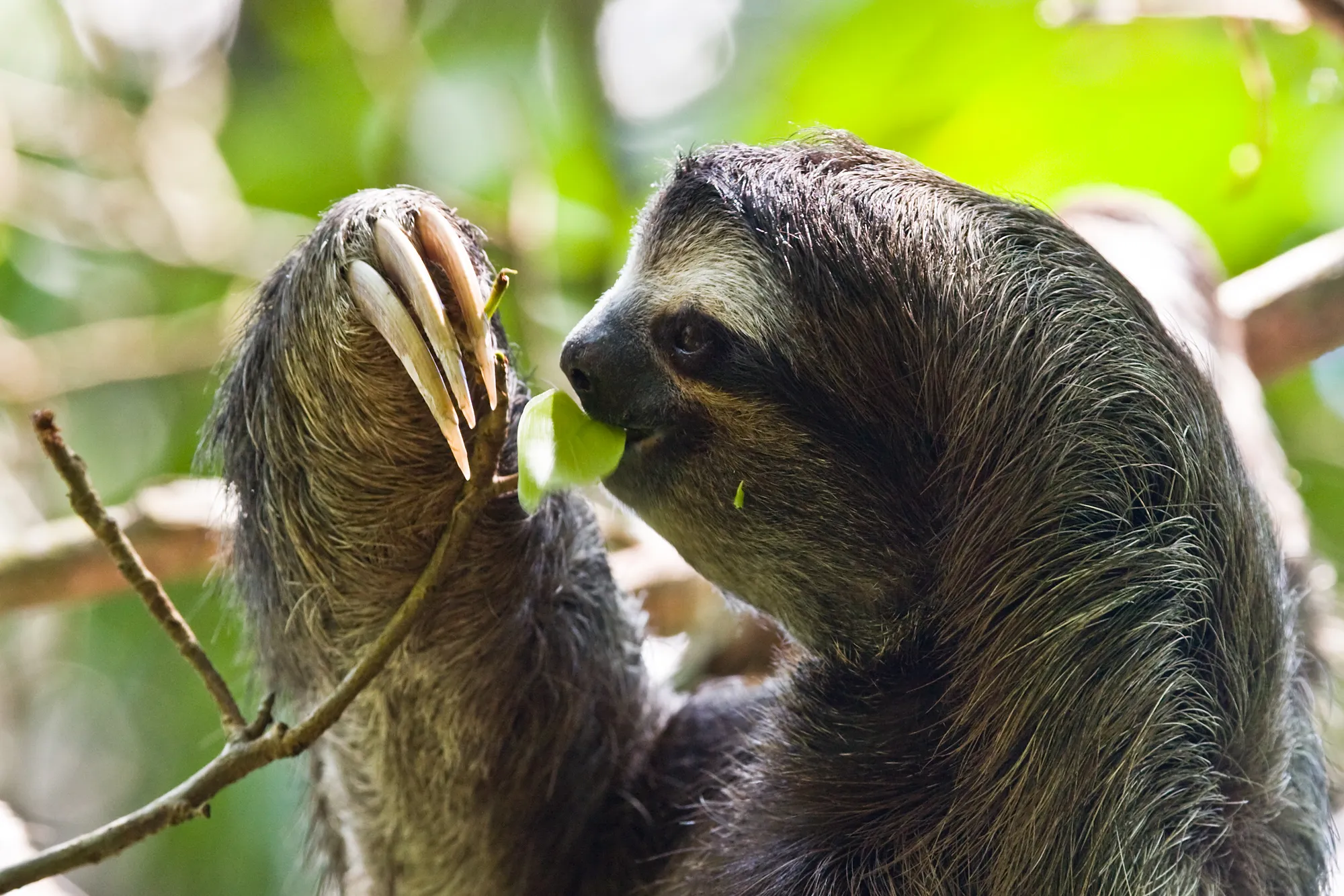
Throughput, glacial by design. The stomach has multiple fermentation chambers, is effectively always full, and can make up — with the rest of the gut — over a third of the animal’s mass. Passage estimates in the literature run from about 157 hours to, at the extreme, 50 days. A sloth is best understood as a slow-cooker that grew claws.
The sleep audit
The laziest fact about sloths is wrong
The one thing everyone knows — sloths sleep most of the day — came from watching bored animals in cages. In 2008 a team put EEG caps on wild three-toed sloths on Barro Colorado Island, the first brainwave recordings ever taken from any wild animal, and the number came back six hours lighter.
Wild sloths sleep 9.6 hours a day — the famous 16-hour figure was measured in captivity
Hours of sleep per day on a full 24-hour axis. The hatched bar is a 1966 claim from watching captive animals; the grey bar is the only captive EEG study (1983, mixed adults and juveniles); the highlighted bar is the wild EEG measurement (2008, three adult females, 12.8 recording-days).
Source: Rattenborg et al. 2008, Biology Letters 4:402–405 (wild EEG, and the paper's account of Galvão de Moura Filho et al. 1983); Tirler 1966 via Hayssen 2010, Mammalian Species.
Outputs
Thirty-eight metres is a big day
The 1973 radio-tracking study that first followed sloths day by day found three-toed animals in the same tree on consecutive days 40% of the time, and rarely covering more than 38 metres in a day. Under a branch they cruise at about 0.09 metres per second. The all-time recorded hurry: three metres in one minute, achieved at the onset of a rainstorm.
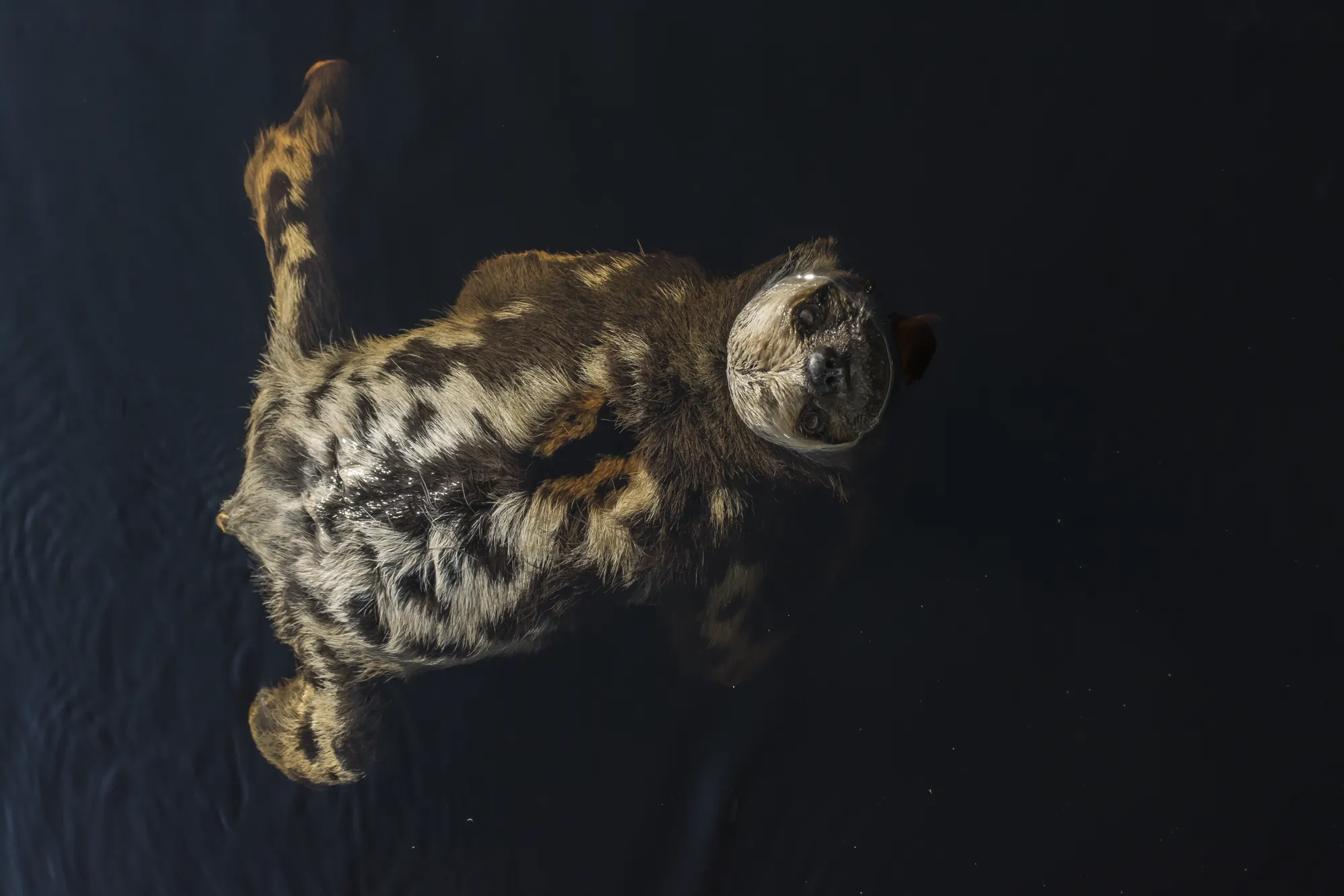
The genuine surprise is water. Sloths swim — well, and apparently gladly, doing a head-up breaststroke between flooded trees. In the Amazon’s flood season it is a normal part of getting around.
Checked — what gets repeated vs what was measured
Wild EEG says 9.63 ± 0.51 hours (Rattenborg et al. 2008). The big numbers came from captivity: 15.85 h in the one captive EEG study, “15–18 h” from mid-century observation. The chart above is the whole story.
The measured basis is a 1942 respiration study in which immobilized three-toed sloths managed about 15 minutes of forced apnea (Irving, Scholander & Grinnell 1942, traced via the Sloth Conservation Foundation’s own myth page). Forty minutes is the internet’s compound interest on that number.
Repeated everywhere — including by the leading sloth NGO — but we could find no published measurement of sloth swimming speed at all. They demonstrably swim well; the “3×” is a factoid without a source.
Inside the published envelope but at its far edge: literature estimates run 157 hours to 50 days (Cliffe et al. 2015), and the measured retention times cluster around six to seven days. “A week or two, sometimes much longer” is the honest version.
Sources for this page
- Pauli et al. 2016, The American Naturalist — wild FMR, doubly-labelled water
- UW–Madison release for the same study — the ~460 kJ / 110 kcal framing
- Cliffe et al. 2018, PeerJ — resting metabolism 40% under Kleiber; body-temperature logging; heat-idle
- Hayssen 2010, Mammalian Species — Grand's muscle figure, McNab's thermoregulation, the rainstorm sprint
- Mossor et al. 2020, Integrative Organismal Biology — tendon safety factors for passive hanging
- Morgan et al. 2023, Journal of Anatomy — ~90% slow-twitch fibre; 0.09 m/s suspensory speed
- Cliffe et al. 2015, PeerJ — digesta passage range, the 37% abdominal figure
- Rattenborg et al. 2008, Biology Letters — wild sloth EEG sleep
- Sunquist & Montgomery 1973, Journal of Mammalogy — 38 m/day
- Sloth Conservation Foundation — the breath-hold myth traced to Irving et al. 1942
The two-toed sloth’s wild daily figure sits in the same 2016 paper behind a paywall; only the three-toed numbers are quoted here, from sources we loaded. Next: the one expensive thing a sloth does.